
This repo is maintained by lobsters/claws, not by a conventional human-only dev team. The people behind the system are Bellman / Yeachan Heo and friends like Yeongyu, but the repo itself is being pushed forward by autonomous claw workflows: parallel coding sessions, event-driven orchestration, recovery loops, and machine-readable lane state. In practice, that means this project is not just about coding agents — it is being actively built by them. Features, tests, telemetry, docs, and workflow hardening are landed through claw-driven loops using clawhip, oh-my-openagent, oh-my-claudecode, and oh-my-codex.
Rewriting Project Claw Code
<p align="center"> <strong>⭐ The fastest repo in history to surpass 50K stars, reaching the milestone in just 2 hours after publication ⭐</strong> </p> <p align="center"> <a href="https://star-history.com/#ultraworkers/claw-code&Date"> <picture> <source media="(prefers-color-scheme: dark)" srcset="https://api.star-history.com/svg?repos=ultraworkers/claw-code&type=Date&theme=dark" /> <source media="(prefers-color-scheme: light)" srcset="https://api.star-history.com/svg?repos=ultraworkers/claw-code&type=Date" /> <img alt="Star History Chart" src="https://api.star-history.com/svg?repos=ultraworkers/claw-code&type=Date" width="600" /> </picture> </a> </p> <p align="center"> <img src="assets/clawd-hero.jpeg" alt="Claw" width="300" /> </p> <p align="center"> <strong>Autonomously maintained by lobsters/claws — not by human hands</strong> </p> <p align="center"> <a href="https://github.com/Yeachan-Heo/clawhip">clawhip</a> · <a href="https://github.com/code-yeongyu/oh-my-openagent">oh-my-openagent</a> · <a href="https://github.com/Yeachan-Heo/oh-my-claudecode">oh-my-claudecode</a> · <a href="https://github.com/Yeachan-Heo/oh-my-codex">oh-my-codex</a> · <a href="https://discord.gg/6ztZB9jvWq">UltraWorkers Discord</a> </p>[!IMPORTANT] The active Rust workspace now lives in
rust/. Start withUSAGE.mdfor build, auth, CLI, session, and parity-harness workflows, then userust/README.mdfor crate-level details.
Want the bigger idea behind this repo? Read
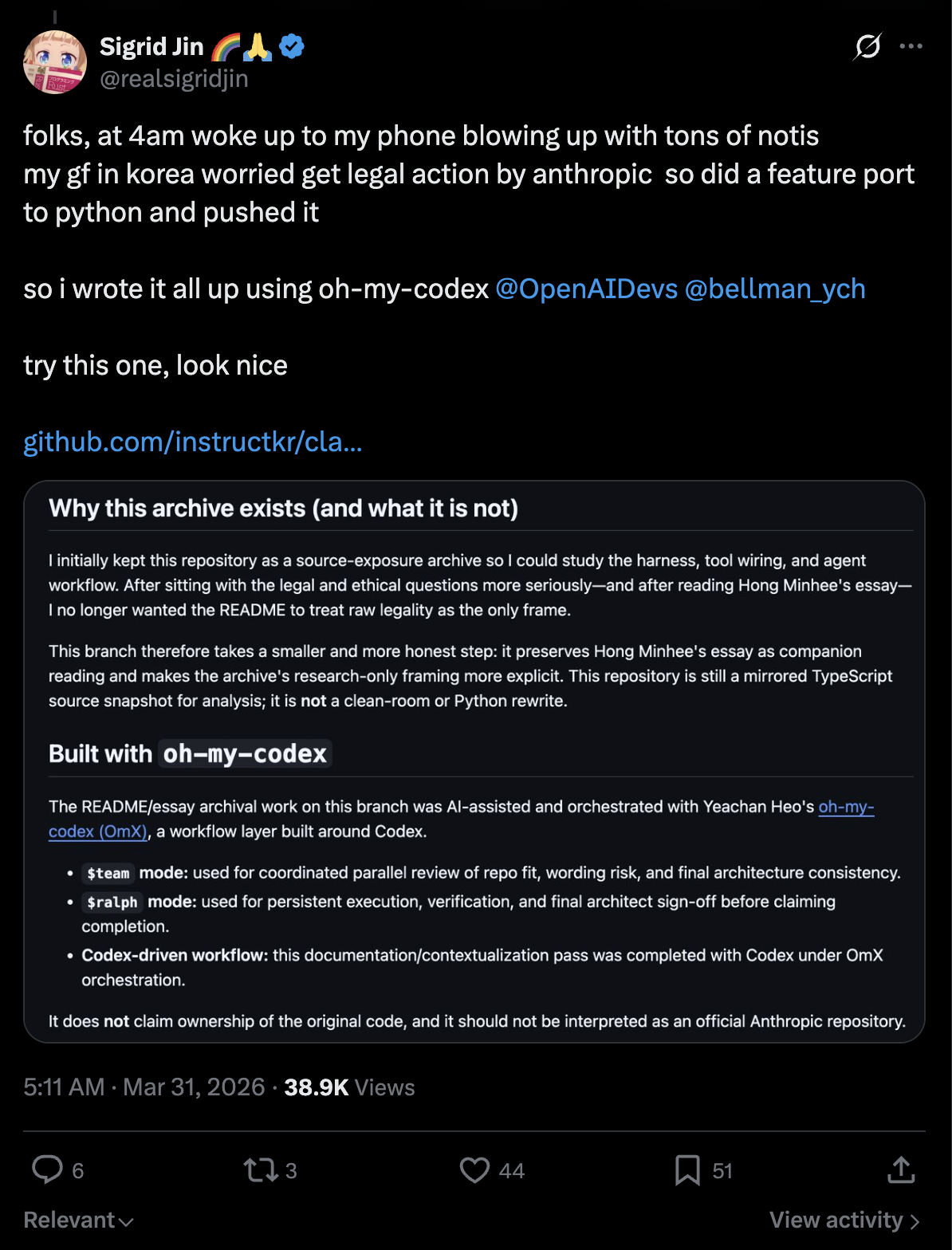
PHILOSOPHY.mdand Sigrid Jin's public explanation: https://x.com/realsigridjin/status/2039472968624185713
Shout-out to the UltraWorkers ecosystem powering this repo: clawhip, oh-my-openagent, oh-my-claudecode, oh-my-codex, and the UltraWorkers Discord.
Backstory
This repo is maintained by lobsters/claws, not by a conventional human-only dev team.
The people behind the system are Bellman / Yeachan Heo and friends like Yeongyu, but the repo itself is being pushed forward by autonomous claw workflows: parallel coding sessions, event-driven orchestration, recovery loops, and machine-readable lane state.
In practice, that means this project is not just about coding agents — it is being actively built by them. Features, tests, telemetry, docs, and workflow hardening are landed through claw-driven loops using clawhip, oh-my-openagent, oh-my-claudecode, and oh-my-codex.
This repository exists to prove that an open coding harness can be built autonomously, in public, and at high velocity — with humans setting direction and claws doing the grinding.
See the public build story here:
https://x.com/realsigridjin/status/2039472968624185713

Porting Status
The main source tree is now Python-first.
src/contains the active Python porting workspacetests/verifies the current Python workspace- the exposed snapshot is no longer part of the tracked repository state
The current Python workspace is not yet a complete one-to-one replacement for the original system, but the primary implementation surface is now Python.
Why this rewrite exists
I originally studied the exposed codebase to understand its harness, tool wiring, and agent workflow. After spending more time with the legal and ethical questions—and after reading the essay linked below—I did not want the exposed snapshot itself to remain the main tracked source tree.
This repository now focuses on Python porting work instead.
Repository Layout
.
├── src/                                # Python porting workspace
│   ├── __init__.py
│   ├── commands.py
│   ├── main.py
│   ├── models.py
│   ├── port_manifest.py
│   ├── query_engine.py
│   ├── task.py
│   └── tools.py
├── tests/                              # Python verification
├── assets/omx/                         # OmX workflow screenshots
├── 2026-03-09-is-legal-the-same-as-legitimate-ai-reimplementation-and-the-erosion-of-copyleft.md
└── README.md
Python Workspace Overview
The new Python src/ tree currently provides:
port_manifest.py— summarizes the current Python workspace structuremodels.py— dataclasses for subsystems, modules, and backlog statecommands.py— Python-side command port metadatatools.py— Python-side tool port metadataquery_engine.py— renders a Python porting summary from the active workspacemain.py— a CLI entrypoint for manifest and summary output
Quickstart
Render the Python porting summary:
python3 -m src.main summary
Print the current Python workspace manifest:
python3 -m src.main manifest
List the current Python modules:
python3 -m src.main subsystems --limit 16
Run verification:
python3 -m unittest discover -s tests -v
Run the parity audit against the local ignored archive (when present):
python3 -m src.main parity-audit
Inspect mirrored command/tool inventories:
python3 -m src.main commands --limit 10
python3 -m src.main tools --limit 10
Current Parity Checkpoint
The port now mirrors the archived root-entry file surface, top-level subsystem names, and command/tool inventories much more closely than before. However, it is not yet a full runtime-equivalent replacement for the original TypeScript system; the Python tree still contains fewer executable runtime slices than the archived source.
Built with oh-my-codex
The restructuring and documentation work on this repository was AI-assisted and orchestrated with Yeachan Heo's oh-my-codex (OmX), layered on top of Codex.
$teammode: used for coordinated parallel review and architectural feedback$ralphmode: used for persistent execution, verification, and completion discipline- Codex-driven workflow: used to turn the main
src/tree into a Python-first porting workspace
OmX workflow screenshots

Ralph/team orchestration view while the README and essay context were being reviewed in terminal panes.

Split-pane review and verification flow during the final README wording pass.
Community
<p align="center"> <a href="https://instruct.kr/"><img src="assets/instructkr.png" alt="instructkr" width="400" /></a> </p>Join the instructkr Discord — the best Korean language model community. Come chat about LLMs, harness engineering, agent workflows, and everything in between.

Star History
See the chart at the top of this README.
Ownership / Affiliation Disclaimer
- This repository does not claim ownership of the original Claude Code source material.
- This repository is not affiliated with, endorsed by, or maintained by Anthropic.
Videos
So Claude Code's Source Code Was Just Leaked...
ForrestKnight · 105K views
How to Install Claw Code in 5 Minutes (Open Source Claude Code)
Matt Holztrager · 54K views
How to Install Claw Code in 5 Steps (Claude code open source)
Skyrocketing Tech · 7K views
You might also like
Other
quip protocol rs
A fresh Substrate node, ready for hacking :rocket: A standalone version of this template is available for each release of Polkadot in the Substrate Developer Hub Parachain Template repository. The parachain template is generated directly at each Polkadot release branch from the Solochain Template in Substrate upstream It is usually best to use the stand-alone version to start a new project. All bugs, suggestions, and feature requests should be made upstream in the Substrate repository.
Other
autoskills
One command. Your entire AI skill stack. Installed. Scans your project, detects your tech stack, and installs curated AI agent skills automatically. 1. Run npx autoskills in your project root 2. Your package.json, Gradle files, and config files are scanned to detect technologies 3. The best matching AI agent skills are selected from the audited autoskills registry 4. Only the selected skill files are downloaded from the registry and verified before writing them locally
Other
turboquant plus
Download ready-to-run builds from Releases. No build tools needed. Unpack and run. Includes llama-server, llama-bench, llama-cli, and all tools. Implementation of TurboQuant (ICLR 2026) with implementation work, experiments, and follow-on findings beyond the base paper. KV cache compression for local LLM inference.
Other
OmniVoice
OmniVoice is a state-of-the-art massively multilingual zero-shot text-to-speech (TTS) model supporting over 600 languages. Built on a novel diffusion language model-style architecture, it generates high-quality speech with superior inference speed, supporting voice cloning and voice design. Choose one of the following methods: pip or uv. Intel Arc GPUs (Alchemist and Battlemage architectures) are supported via PyTorch's XPU backend.